
TOPIC
Roata Ferris: History, Design, Uses, and Why Ferris Wheels Remain a Global Attraction


Introduction
The term roata ferris is commonly used in several languages to describe a Ferris wheel, one of the most recognizable attractions in amusement parks and city skylines around the world. From historic fairs to modern observation wheels that tower above major cities, these iconic structures continue to attract millions of visitors every year.
A Ferris wheel offers much more than a simple ride. It combines engineering, entertainment, tourism, and breathtaking views into a single experience. Whether located in a theme park, a festival, or a metropolitan observation center, Ferris wheels remain symbols of fun and innovation.
In this guide, you’ll learn about the history of the Ferris wheel, how it works, its benefits, common design types, and why it continues to be one of the most popular attractions worldwide.
What Is a Roata Ferris?
A roata ferris is a large rotating wheel mounted vertically on a central axis. Passenger cabins or gondolas are attached around the rim, allowing riders to enjoy elevated views while the wheel slowly rotates.
Key Characteristics
- Circular rotating structure
- Passenger cabins attached around the rim
- Slow and smooth movement
- Designed for sightseeing and entertainment
- Found in amusement parks, fairs, and urban attractions
Unlike thrill rides that focus on speed and excitement, Ferris wheels emphasize comfort, panoramic views, and accessibility for people of all ages.
The History of the Ferris Wheel
The modern Ferris wheel was introduced in the late nineteenth century and quickly became a landmark attraction.
Origins
The first Ferris wheel was designed by engineer George Washington Ferris Jr. for the 1893 World’s Columbian Exposition in Chicago. The structure demonstrated engineering excellence and provided visitors with a completely new entertainment experience.
Evolution Through the Years
As technology improved, Ferris wheels became larger, safer, and more sophisticated. Today, many cities feature giant observation wheels that serve as tourist landmarks rather than traditional amusement rides.
| Era | Major Development | Impact |
|---|---|---|
| 1890s | First Ferris wheel introduced | Created a new attraction category |
| Early 1900s | Expansion into fairs and parks | Increased popularity worldwide |
| Mid-1900s | Improved steel construction | Greater safety and durability |
| Modern Era | Observation wheels in cities | Tourism and sightseeing growth |
Many modern wheels now feature climate-controlled cabins, LED lighting systems, and advanced safety technologies.
How Does a Ferris Wheel Work?
Understanding how a Ferris wheel operates helps explain why it remains one of the safest amusement attractions.
Basic Components
A Ferris wheel consists of several essential parts:
Wheel Structure
The wheel itself is constructed from strong steel components designed to support significant weight.
Support Towers
Large support beams stabilize the wheel and distribute loads safely.
Passenger Cabins
Cabins are suspended around the rim and often remain level through gravity or specialized mechanisms.
Drive System
Electric motors rotate the wheel at controlled speeds.
Simple Operating Process
- Passengers enter cabins.
- The wheel begins rotating slowly.
- Cabins move upward while remaining upright.
- Riders enjoy panoramic views.
- The wheel completes several rotations.
- Passengers exit safely.
Types of Ferris Wheels
Not all Ferris wheels are identical. Different designs serve different purposes and environments.
Traditional Ferris Wheels
These are commonly found at amusement parks and traveling fairs.
Features include:
- Open or semi-enclosed cabins
- Moderate height
- Family-friendly operation
- Portable or permanent installation
Observation Wheels
Observation wheels are larger and often located in urban tourist destinations.
Features include:
- Enclosed climate-controlled cabins
- Luxury experiences
- City skyline views
- Permanent structures
Transportable Ferris Wheels
These models are designed to travel between events and festivals.
Benefits include:
- Quick assembly
- Mobility
- Lower installation costs
- Event flexibility
| Wheel Type | Typical Height | Main Purpose |
|---|---|---|
| Traditional | 20–60 meters | Entertainment |
| Observation | 100+ meters | Tourism |
| Portable | 15–50 meters | Events and fairs |
| Luxury Observation | 150+ meters | Premium sightseeing |
Why Ferris Wheels Remain Popular
Despite the rise of advanced amusement rides, Ferris wheels continue to attract visitors across generations.
Universal Appeal
A Ferris wheel is suitable for:
- Children
- Teenagers
- Adults
- Seniors
- Families
- Couples
This broad appeal helps maintain its popularity.
Stunning Views
One of the primary reasons people choose a Ferris wheel is the opportunity to see landscapes from above.
Popular viewing opportunities include:
- City skylines
- Waterfronts
- Mountains
- Theme parks
- Festivals
Relaxing Experience
Unlike roller coasters, Ferris wheels provide a calm and enjoyable ride experience.
Visitors can:
- Take photographs
- Enjoy conversations
- Appreciate scenery
- Experience gentle movement
Engineering Behind Modern Ferris Wheels
Modern Ferris wheels represent significant engineering achievements.
Structural Design
Engineers carefully calculate:
- Wind resistance
- Load distribution
- Material strength
- Rotational balance
These calculations ensure safe operation under various conditions.
Advanced Safety Systems
Today’s Ferris wheels use multiple safety features.
| Safety Feature | Purpose |
|---|---|
| Backup power systems | Maintain operation during outages |
| Emergency brakes | Controlled stopping capability |
| Structural monitoring | Detect stress and wear |
| Weather monitoring | Protect against severe conditions |
| Cabin locking systems | Prevent accidental opening |
Sustainable Technology
Many modern observation wheels incorporate:
- Energy-efficient motors
- LED lighting
- Smart monitoring systems
- Sustainable construction materials
As a result, operators can reduce environmental impact while maintaining excellent visitor experiences.
Ferris Wheels as Tourist Attractions
Many cities have transformed Ferris wheels into iconic landmarks.
Economic Benefits
Large observation wheels contribute to local economies through:
- Tourism spending
- Job creation
- Hospitality growth
- Increased visitor traffic
City Branding
Cities often use observation wheels as recognizable symbols.
Benefits include:
- Improved skyline identity
- Increased international recognition
- Enhanced tourism marketing
- Stronger local pride
Event Hosting Opportunities
Observation wheels frequently become focal points during:
- Festivals
- Holiday celebrations
- Fireworks displays
- Cultural events
This versatility increases their value as community attractions.
Pros and Cons of Ferris Wheels
Every attraction offers advantages and limitations.
Pros
- Suitable for all age groups
- Excellent sightseeing opportunities
- Relatively safe operation
- Family-friendly experience
- Iconic visual appeal
- Supports tourism development
Cons
- Weather-dependent operation
- High construction costs
- Requires significant maintenance
- Limited thrill factor for adrenaline seekers
- Large space requirements
Understanding these factors helps operators determine whether a Ferris wheel is suitable for a specific location.
Common Mistakes When Visiting a Ferris Wheel
Visitors can improve their experience by avoiding common errors.
Arriving During Peak Hours
Long lines often occur during weekends and holidays.
Ignoring Weather Conditions
Poor visibility can reduce sightseeing opportunities.
Forgetting a Camera
Many of the best views are available only during the ride.
Not Checking Operating Hours
Some observation wheels have seasonal schedules.
Best Practices for Enjoying a Ferris Wheel Ride
To maximize the experience, consider these recommendations.
Choose the Right Time
The best times often include:
- Sunrise
- Sunset
- Evening city light displays
Research the Location
Learn about nearby attractions before visiting.
Book Tickets Early
Popular observation wheels may sell out during peak travel periods.
Sit Near Windows
This provides better opportunities for photography and sightseeing.
Check Weather Forecasts
Clear skies generally provide the most impressive views.
Future Trends in Ferris Wheel Design
The future of Ferris wheel technology looks promising.
Emerging innovations include:
- Smart cabin technology
- Interactive passenger experiences
- Renewable energy integration
- Enhanced accessibility features
- Advanced digital ticketing systems
As urban tourism grows, observation wheels will likely continue serving as major attractions in cities worldwide.
Conclusion
The roata ferris remains one of the world’s most beloved attractions because it combines engineering excellence, sightseeing opportunities, and family-friendly entertainment. From its origins at the 1893 Chicago exposition to today’s massive observation wheels, the Ferris wheel has evolved into a symbol of tourism and innovation.
Whether you’re visiting a local amusement park or exploring a world-famous city landmark, a Ferris wheel offers a unique perspective that few attractions can match. Its timeless appeal, accessibility, and scenic views ensure it will remain a favorite attraction for generations to come.
Frequently Asked Questions
1. What does roata ferris mean?
Roata ferris is a term used in several languages to refer to a Ferris wheel, a large rotating ride with passenger cabins attached around its rim.
2. Who invented the Ferris wheel?
George Washington Ferris Jr. designed the first Ferris wheel for the 1893 World’s Columbian Exposition in Chicago.
3. Are Ferris wheels safe?
Yes. Modern Ferris wheels use advanced engineering, monitoring systems, and multiple safety mechanisms to ensure safe operation.
4. What is the difference between a Ferris wheel and an observation wheel?
Observation wheels are generally larger, feature enclosed cabins, and focus on sightseeing rather than amusement park entertainment.
5. Why are Ferris wheels popular tourist attractions?
They provide panoramic views, family-friendly experiences, and iconic landmarks that attract visitors throughout the year.
TOPIC
ScopeSynthesis.com: A Comprehensive Guide to Website Traffic, Domain Valuation, and SEO Analysis

Introduction
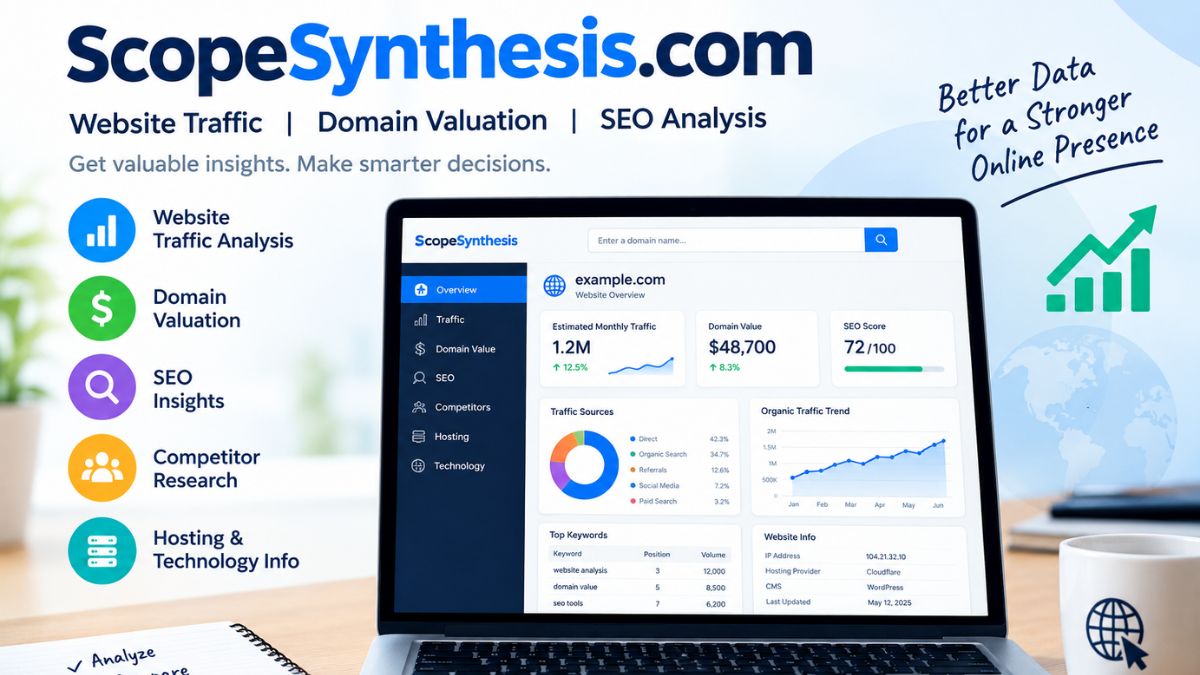
In the competitive world of digital marketing, understanding website performance is essential for website owners, bloggers, SEO professionals, and online businesses. ScopeSynthesis.com is a domain analytics platform designed to help users explore website traffic, estimate domain values, and examine important performance metrics. It aims to provide a practical alternative to established website analysis platforms by making useful domain information easier to access.
Whether you want to evaluate a competitor, research a potential domain purchase, or understand your website’s online presence, Scope Synthesis offers an approach centered on collecting and interpreting website data. According to its published description, the platform combines traffic insights, domain valuation, and SEO-related information in one place.
What Is ScopeSynthesis.com?
ScopeSynthesis.com is an online website analysis tool that helps users investigate the performance and potential value of domains. Instead of relying exclusively on a website’s appearance or published content, users can explore available analytical information to develop a better understanding of its digital presence.
The platform is designed for people who want to make informed decisions about websites, including digital marketers, bloggers, business owners, developers, and domain investors.
Its stated capabilities include website traffic analysis, domain valuation, SEO metrics, and technical information about website hosting. These features can be useful when researching competitors, evaluating business opportunities, or reviewing a website before investing time and money in it.
Key Features of ScopeSynthesis.com
1. Website Traffic Analysis
Website traffic is an important indicator of online visibility. Scope Synthesis aims to help users understand how websites attract visitors and where their traffic originates.
Traffic analysis can help website owners investigate potential audience sources, compare competing websites, and identify opportunities to improve their marketing strategies.
However, estimated traffic figures should not be treated as exact visitor counts. Actual website analytics from tools such as Google Analytics generally provide more reliable first-party information about a site’s visitors.
2. Domain Valuation
A domain name can become a valuable digital asset when it has strong branding potential, relevant demand, and a useful online history.
Scope Synthesis describes domain valuation as one of its main capabilities. Such estimates may help users begin evaluating a domain before purchasing, selling, or developing it.
Domain value can depend on several factors, including:
- Domain name length and memorability.
- Keyword relevance and commercial potential.
- Existing website traffic and search visibility.
- Quality and relevance of backlinks.
- Brand potential and market demand.
- Historical use and reputation.
Automated valuations should be considered estimates rather than guaranteed selling prices. Buyers and sellers should also review comparable sales and the domain’s history before making financial decisions.
3. SEO Performance Insights
Search engine optimization helps websites attract visitors through organic search results. Monitoring SEO-related metrics can reveal areas that may deserve further investigation.
Scope Synthesis positions itself as a platform for exploring website performance metrics, including SEO-related information. These insights may help users compare websites and investigate their search visibility.
For a more complete SEO strategy, website owners should also examine keyword rankings, content quality, search intent, indexing status, backlinks, and technical SEO issues.
4. Competitor Research
Competitor analysis is an important part of developing a successful online business. By examining competing websites, marketers can identify content opportunities, study audience acquisition strategies, and discover areas where their own websites may be underperforming.
Scope Synthesis can serve as a starting point for this research by bringing domain-related information together in a single analytical environment.
For example, a blogger planning a technology website could investigate established competitors, compare their apparent online presence, and use the findings to guide content planning.
5. Website Technology and Hosting Information
A website’s technical setup can influence its performance, security, reliability, and ability to scale.
Scope Synthesis describes its coverage as extending beyond traffic and valuation to technical website metrics, including hosting-related information.
Such information can provide useful background when researching websites or investigating competitors. Nevertheless, technical details should be verified independently before making decisions about hosting providers, website security, or infrastructure.
Who Can Benefit from ScopeSynthesis.com?
Bloggers and Content Creators
Bloggers can use website research tools to evaluate potential niches, investigate competing publications, and identify opportunities for content development.
For example, someone planning a finance, technology, travel, or lifestyle blog could research existing websites before deciding which topics to prioritize.
SEO Professionals
SEO professionals frequently need to compare domains, review competitor performance, and identify potential opportunities for organic growth.
A domain analysis platform can help organize preliminary research, although specialized SEO tools may still be necessary for detailed keyword tracking, backlink audits, and technical website analysis.
Website Owners
Website owners can use analytical information to better understand their online presence and identify areas requiring further investigation.
Combining domain research with first-party analytics and search performance reports can provide a more complete picture of website growth.
Domain Investors
Domain investors often evaluate names according to their branding potential, market demand, and commercial relevance.
Scope Synthesis’s domain valuation feature may help users conduct initial research. However, a domain should never be purchased solely because an automated tool assigns it a high estimated value.
Digital Marketing Agencies
Marketing agencies can benefit from tools that simplify initial domain research and competitor comparisons. These insights may support client discussions, market assessments, and campaign planning.
Agencies should verify important findings using additional data sources before presenting them as confirmed performance figures.
How to Use ScopeSynthesis.com
Using a website analysis platform generally involves a straightforward research process.
Step 1: Visit the Website
Open ScopeSynthesis.com in your browser and explore the available tools and features.
Step 2: Enter a Domain
If the platform provides a domain search function, enter the website address you want to investigate.
Step 3: Review Available Metrics
Examine the traffic estimates, domain valuation, SEO information, and technical details provided for the selected website.
Step 4: Compare Relevant Websites
Repeat the process for competing domains to identify similarities, differences, and potential research opportunities.
Step 5: Verify Important Findings
Use independent tools and reliable first-party information to validate important figures before making marketing, purchasing, or investment decisions.
The available data and specific features may change as the platform develops, so users should check the website directly for its current functionality and access requirements.
ScopeSynthesis.com Compared With Other Website Analysis Tools
Several established platforms offer website analytics and SEO research capabilities. Scope Synthesis positions itself as an alternative for users interested in domain traffic, valuation, and related metrics.
Popular alternatives include Similarweb, Semrush, and Ahrefs.
- Similarweb is commonly used to investigate website traffic, audience behavior, and competitive digital intelligence.
- Semrush provides tools for keyword research, SEO analysis, competitor research, and digital marketing.
- Ahrefs is widely used for backlink analysis, keyword research, and organic search competitor analysis.
- Scope Synthesis focuses on domain analytics, estimated website traffic, domain valuation, and additional website performance metrics.
The best option depends on your needs, budget, and the depth of data you require. Users should compare the platforms’ current features, limitations, and pricing rather than assuming that all metrics are equally comprehensive or accurate.
Benefits of Using ScopeSynthesis.com
One potential advantage of a domain analysis platform is the convenience of examining several categories of website information in one place.
Other potential benefits include:
- Simplified research: Explore available domain information without relying entirely on manual investigation.
- Competitive insights: Investigate competing websites and identify areas for further research.
- Domain evaluation: Obtain an initial perspective on the potential value of a website.
- Marketing support: Use available metrics to inform content and SEO planning.
- Time efficiency: Organize preliminary website research within a single platform.
The practical value of these benefits depends on the accuracy, coverage, and accessibility of the platform’s actual data.
Limitations to Consider
Although website analysis tools can be helpful, their results should be interpreted carefully.
Traffic estimates may differ significantly from actual visitor counts. Automated domain valuations cannot guarantee what a buyer will pay. SEO metrics may also vary between platforms because each provider uses different data sources and calculation methods.
Users should check whether the information is current, understand which metrics are estimates, and confirm important findings through independent sources.
It is also sensible to review the platform’s privacy policy and terms of service before submitting sensitive business information or connecting accounts.
Tips for Getting Better Results From Domain Research
To get more value from Scope Synthesis or a similar website analysis platform, follow a structured research process.
First, define your objective. Researching a competitor requires a different approach from buying a domain or auditing your own website.
Second, compare multiple relevant websites instead of judging a domain in isolation. Look for patterns in traffic, content, branding, and search visibility.
Third, combine estimated metrics with reliable sources such as Google Search Console, Google Analytics, and other relevant SEO tools.
Finally, use the findings to guide practical decisions. For example, if competitor research reveals an underserved topic, consider publishing useful, original content that directly answers the audience’s questions.
Is ScopeSynthesis.com Worth Exploring?
ScopeSynthesis.com may be worth exploring for users who want a convenient starting point for domain research and website performance analysis. Its stated focus on traffic insights, domain valuation, SEO-related metrics, and technical website information makes it relevant to bloggers, marketers, website owners, and domain investors.
However, its suitability depends on the features currently available and the reliability of the information it provides. Users who require advanced keyword research, detailed backlink analysis, or highly accurate visitor data may need to supplement it with other services.
The most effective approach is to test the platform against your specific research needs and compare its findings with trusted alternatives.
Conclusion
ScopeSynthesis.com is a domain analytics platform designed to help users explore website traffic, estimated domain values, SEO-related metrics, and other aspects of website performance. It offers a potential starting point for competitor research, domain evaluation, and digital marketing planning.
For bloggers, SEO professionals, online entrepreneurs, and domain investors, understanding these metrics can support better-informed decisions. Nevertheless, no single analytical tool provides a complete picture of a website’s performance or commercial value.
By combining Scope Synthesis with reliable analytics, independent verification, and a clear research strategy, users can gain more meaningful insights into the websites they manage, study, or consider purchasing.
Frequently Asked Questions (FAQs)
1. What is ScopeSynthesis.com?
ScopeSynthesis.com is an online domain analytics platform designed to provide insights into website traffic, domain valuation, SEO-related metrics, and other website performance information.
2. Is ScopeSynthesis.com free to use?
The platform has been described by a third-party software directory as offering a free option. Users should visit the official website to confirm current access conditions and any usage limitations.
3. Can Scope Synthesis estimate a domain’s value?
Yes. Domain valuation is one of the capabilities described by the platform. However, an estimated value is not a guaranteed selling price.
4. Who should use ScopeSynthesis.com?
Bloggers, website owners, SEO professionals, digital marketing agencies, and domain investors may find domain analysis tools useful for preliminary research.
5. Can ScopeSynthesis.com help with SEO?
Its stated SEO-related metrics may help users investigate website performance and competitors. A comprehensive SEO strategy may require additional tools for keyword research, backlink analysis, indexing checks, and technical audits.
6. Is Scope Synthesis an alternative to Similarweb?
Scope Synthesis positions itself as an alternative to Similarweb for domain and website analysis. The best choice depends on the data, features, and level of detail required.
7. Are website traffic estimates always accurate?
No. Third-party traffic estimates can differ from actual website analytics. For your own website, first-party analytics and search performance data are generally better sources for measuring real performance.
8. How can I get started with ScopeSynthesis.com?
Visit the website, review its available features, enter a domain if a search tool is available, and examine the resulting information. Verify important findings before making decisions.


Visual content has become an important part of communication. From social media posts and blog articles to presentations, advertisements, and personal projects, people increasingly rely on images to explain ideas and capture attention. Traditionally, creating a high-quality image required photography equipment, design software, illustration skills, or the help of a professional designer. Artificial intelligence is changing that process.
Today, anyone with a written description can use an AI image generator to turn an idea into a visual concept. Many platforms also provide free access, making AI-assisted image creation available to students, creators, small businesses, and casual users who may not have professional design experience.
What Is an AI Image Generator?
An AI image generator is a digital tool that uses machine-learning models to create images based on instructions provided by a user. These instructions, commonly called prompts, can describe a subject, setting, artistic style, lighting, composition, colors, or mood.
For example, a user could request an image of a small café on a rainy evening with warm lights glowing through the windows. The system interprets the description and produces an image based on the characteristics included in the prompt.
Modern systems can create a wide variety of visuals, including realistic scenes, illustrations, concept art, product-style images, fantasy environments, and abstract designs.
Why Free AI Image Tools Are Becoming Popular
One of the biggest advantages of free AI image tools is accessibility. Creating digital artwork no longer necessarily requires expensive software or advanced technical knowledge.
A beginner can start with a simple description and experiment with different prompts. This makes the technology useful for people who may have creative ideas but lack traditional drawing or graphic-design skills.
Free tools can also be useful when someone needs a quick visual for a blog post, presentation, classroom project, social media concept, or personal experiment. Instead of searching through stock-image libraries for something that closely matches an idea, users can attempt to create a customized image.
However, “free” does not always mean unlimited. Some platforms may restrict the number of generations, image resolution, editing features, or commercial usage available without payment. Users should therefore check the terms of a service before using generated images for professional or commercial purposes.
Common Uses for AI-Generated Images
The applications of AI image generation continue to expand. Content creators can use generated visuals when developing concepts for articles, videos, and social media campaigns. Writers may use them to visualize fictional settings or characters, while educators can create illustrations that make certain topics easier to understand.
Small businesses may also use AI-generated visuals during the early stages of branding or campaign development. For example, a business owner could create several visual concepts before deciding what type of professional photography or design work is actually needed.
Designers can use AI differently. Rather than treating generated images as finished products, they can use them as sources of inspiration or starting points for more detailed work.
The Importance of Writing Better Prompts
The quality of an AI-generated image often depends heavily on the instructions given to the system. A vague prompt may produce a generic result, while a more detailed description can provide greater control.
Instead of writing “a beautiful house,” a user might describe a modern two-story house surrounded by trees, photographed during golden hour, with warm interior lighting and a wide-angle composition.
Details such as the subject, environment, perspective, lighting, atmosphere, and artistic style can help communicate the intended result more clearly.
Experimentation is also part of the process. Users may need to adjust their wording several times before obtaining an image that matches their original concept.
AI Images and Human Creativity
AI-generated images have raised interesting questions about the relationship between technology and creativity. While an AI system can produce an image from a prompt, the person using the system still makes decisions about what they want to communicate.
Choosing a concept, developing a prompt, reviewing results, selecting an appropriate version, and refining the idea all involve creative judgment. In this sense, AI can function as a creative tool rather than simply replacing traditional artistic processes.
For professional projects, human review remains particularly important. An AI-generated image may contain unexpected details, inaccurate objects, distorted text, or visual elements that do not fit the intended message.
Copyright and Responsible Use
Another important consideration is how AI-generated images can be used. Rules surrounding copyright, ownership, training data, and commercial use can vary depending on the platform and jurisdiction.
Users should read the terms of the specific AI service before publishing or selling generated images. They should also avoid creating misleading visuals presented as genuine photographs, particularly when the image could influence how people understand a real event or person.
Responsible use also means considering privacy, consent, and intellectual property. Generating an image inspired by a general concept is different from attempting to imitate someone’s protected work or create deceptive content involving real individuals.
What the Future May Look Like
AI image generation is developing quickly. As these systems become more capable, users are likely to gain greater control over composition, editing, consistency, and customization.
The technology may also become increasingly integrated into everyday creative software. Instead of switching between different applications, users could eventually describe an idea, modify individual elements, change a visual style, and produce several variations within a single workflow.
This does not necessarily mean traditional photography, illustration, or graphic design will disappear. Instead, AI may become another tool within the broader creative process.
A New Approach to Visual Creation
The growing availability of free AI image generator has lowered the barrier to visual experimentation. People who previously needed specialized software or professional assistance can now explore ideas using simple written instructions.
The most effective approach is to view these tools as creative assistants rather than automatic replacements for human judgment. Understanding how to write useful prompts, evaluate results, respect usage rights, and refine concepts can make AI-generated imagery much more practical.
As the technology continues to evolve, its greatest value may not simply be the ability to create pictures quickly. It may be the opportunity to turn an idea into something visual—even when the person behind that idea has little or no traditional design experience.

Buying a home in North Texas is about more than finding the right number of bedrooms or an attractive kitchen. From Southlake and Colleyville to Grapevine, Argyle, and surrounding communities, buyers need to weigh the practical details that shape life after closing.
For buyers comparing communities and properties, Southlake TX real estate agent Trisha Atwood provides home-search tools, neighborhood information, property valuation resources, and buyer guidance through Trisha Atwood’s North Texas real estate website. With a focus on Southlake, Grapevine, Colleyville, and Argyle, the site can be a useful local starting point for understanding differences among nearby markets and home styles.
Why A Checklist Matters
A thoughtful checklist helps prevent a fast emotional decision from becoming an expensive long-term mismatch. Buyers may find more choices in some price ranges and neighborhoods, while well-located homes with strong condition, desirable lots, or flexible layouts can still draw serious interest. The best purchase is rarely just the least expensive house or the newest listing. It is the home that fits the household’s budget, routine, priorities, and risk tolerance.
Step One: Set A Realistic Monthly Budget
A mortgage pre-approval identifies a borrowing ceiling, not necessarily a comfortable spending level. Build two numbers before touring: a comfortable payment amount that leaves room for savings and everyday life, plus a firm maximum you will not exceed.
- Principal and interest
- Property taxes, insurance, and any required supplemental coverage
- HOA dues, transfer fees, and special district charges when applicable
- Utilities, seasonal cooling costs, maintenance, and future repairs
- Commute expenses, tolls, moving costs, and furnishings
When comparing tax estimates, review the property’s current information and learn how exemptions may apply through Texas property tax assistance resources. A home’s tax bill can affect affordability just as much as a change in the purchase price.
Step Two: Compare The Location Before The Floor Plan
A beautiful home can become less appealing if it adds too much time to the commute to work, school drop-off, errands, or weekend activities. Visit promising areas on a weekday morning, late afternoon, and evening. Notice traffic patterns, noise, parking, lighting, nearby construction, and the route to the places your household uses most.
Questions To Ask About The Area
- How does the commute feel during peak traffic?
- Are groceries, health care, parks, and child-care options convenient?
- Do sidewalks, trails, road crossings, and street design support your routine?
- Are visible vacant parcels or nearby projects likely to change the setting?
- Does the neighborhood feel quiet, active, social, or more managed by an HOA?
A buyer who chooses a slightly smaller home near work, school, or family may ultimately value regained time more than additional square footage.
Step Three: Check Schools And Community Services Carefully
Listing descriptions are not the final word on school assignments. Confirm current attendance boundaries, transportation options, transfer policies, and program availability directly with the relevant school district. Also consider libraries, parks, recreation programs, emergency services, and how the neighborhood may work for your household several years from now. Schools are one consideration, alongside taxes, commute, lot size, condition, and personal goals.
Step Four: Review The Total Cost Of The Property
Two homes with similar list prices can produce very different monthly and near-term costs. Instead of relying on a table, use the same comparison list for every finalist:
- Estimated monthly payment, including taxes, insurance, and HOA dues.
- Expected utility depends on home size, insulation, window exposure, and HVAC age.
- Likely repair or replacement needs for the roof, water heater, appliances, and mechanical systems.
- Recurring upkeep for pools, extensive landscaping, large lots, gates, or irrigation systems.
- Cash needed for closing, immediate updates, and a reserve for surprises.
Step Five: Inspect For North Texas Home Issues
A general home inspection is essential, but certain properties may warrant further evaluation by qualified specialists. In North Texas, pay close attention to drainage, grading, visible cracking, roof condition, attic ventilation, and the age of major systems. Ask whether repairs were completed with permits, invoices, warranties, or engineering documentation where appropriate.
Before making an offer on a property, use the FEMA Flood Map Service Center to check the official flood hazard mapping for the address, then discuss insurance implications with a qualified insurance professional. Flood-map information is one useful part of due diligence, not a substitute for examining how water moves across the specific lot.
Step Six: Compare New Construction And Resale Homes
New construction can offer current layouts, newer systems, builder warranties, and possible incentives. Buyers should still review the builder contract, construction timeline, included features, lot location, HOA obligations, future phases, and upgrade costs.
Resale homes may offer mature landscaping, established streets, and a clearer view of neighborhood traffic and nearby development. They can also require more immediate maintenance. Neither option automatically represents the better value. Compare condition, location, warranties, lot usability, carrying costs, and your move-in deadline.
Step Seven: Build A Strong But Careful Offer
Price is only one part of an offer. Earnest money, the option period and fee, financing and appraisal terms, requested repairs or credits, closing date, possession needs, and included items can all matter to a seller. Review comparable sales and the home’s condition before deciding on your terms. Do not remove safeguards to appear competitive if the resulting risk exceeds your comfort level.
Common Buyer Questions
Is 2026 A Good Year To Buy In North Texas?
The answer depends on your finances, job stability, savings, timeline, and housing needs. A buyer who can afford the full cost of ownership and finds a suitable home may be better positioned than someone waiting for a perfectly predictable market.
How Much Cash Should Remain After Closing?
Keep a separate reserve for moving, furnishings, maintenance, insurance deductibles, and unexpected repairs. The appropriate amount varies by household, home age, and financial obligations.
Final Pre-Offer Checklist
- Confirm your comfort level and maximum payment amounts.
- Review taxes, insurance, HOA dues, utilities, and repair needs.
- Drive the commute and visit the area at different times.
- Verify schools and community services through reliable local sources.
- Check drainage, flood mapping, roof condition, foundation concerns, and system ages.
- Compare new construction and resale options on total value, not appearance alone.
- Read every offer term and retain protections that matter to you.
A North Texas home search becomes clearer when the full decision is in view. With a realistic budget, careful location research, property-specific due diligence, and disciplined offer terms, buyers can focus on homes that support both present needs and long-term plans.
-

 TOPIC1 year ago
Top 5 Features of Googlediqiu You Didn’t Know About
-

 TOPIC2 years ago
Why Large Waterproof Outdoor Rugs Are Essential for All Outdoor Spaces
-

 FASHION2 years ago
How to Layer Your White Dress for Cold Weather?
-

 TOPIC2 years ago
7 Expert Tips For Choosing The Best Basement Renovation Companies
-

 FASHION1 year ago
How to Choose Sunglasses That Perfectly Complement Your Summer Wardrobe
-

 BUSINESS1 year ago
Top 5 Features of Sowix Online That Every User Should Know About
-

 TOPIC1 year ago
Why Greece Katz Martian Has Everyone Talking in 2025
-

 FINANCE2 years ago
How TraceLoans Can Simplify Your Finances