
TOPIC
Streamlining Access: How Login Vidude Enhances User Experience


In today’s fast-paced digital world, user experience is everything. Users expect seamless access to their favorite apps and websites without the hassle of forgotten passwords or lengthy registration forms. Enter Login Vidude—a revolutionary solution that transforms how we think about online authentication. With a focus on simplicity and security, this innovative tool promises to redefine user interactions across various platforms. Imagine a login process where frustration turns into fluidity; that’s precisely what Login Vidude aims to deliver. Let’s explore how this game-changing service enhances not just security but also the overall user experience for everyone involved.
Common Issues with Traditional Login Methods
Traditional login methods often come with a host of challenges. One major issue is password fatigue. Users are overwhelmed by the need to remember countless passwords for different sites.
Security vulnerabilities also plague conventional logins. Phishing attacks and data breaches have become alarmingly common, putting sensitive information at risk.
User frustration can escalate when faced with forgotten passwords or complicated recovery processes. Many users abandon their accounts entirely rather than go through tedious steps just to regain access.
Additionally, lengthy authentication forms deter potential customers from completing sign-ups or purchases. The more barriers there are, the less likely users are to engage fully with your platform.
These traditional systems often lack flexibility and convenience. With an increasing demand for seamless experiences, outdated methods simply fall short of user expectations in today’s digital landscape.
Features and Benefits of Login Vidude
Login Vidude offers a seamless authentication process that prioritizes user convenience. With its innovative single sign-on feature, users can access multiple platforms without the hassle of remembering numerous passwords.
Security is at the forefront. Advanced encryption protects user data, significantly reducing vulnerabilities associated with traditional login methods. This builds trust and reassures users about their privacy.
Customization plays a key role as well. Businesses can tailor the branding of Login Vidude to match their identity perfectly. This not only enhances brand loyalty but also creates a cohesive experience for users.
Moreover, analytics tools provide insights into user behavior during the login process. These insights help businesses refine their strategies and improve engagement rates over time, making Login Vidude an indispensable tool in today’s digital landscape.
How Login Vidude Enhances User Experience
Login Vidude transforms the user experience by simplifying the authentication process. Users can access their accounts without struggling with complicated password requirements or lengthy forms.
The platform introduces seamless single sign-on capabilities, allowing users to log in through social media or other platforms they already trust. This reduces friction and encourages more frequent interactions.
Moreover, Login Vidude incorporates biometric authentication options like fingerprint scanning and facial recognition. These features not only enhance security but also speed up login times, providing instant access.
Real-time feedback ensures that users are informed at every step of the process. This transparency builds confidence and satisfaction among users as they navigate through various applications.
Login Vidude’s focus on ease of use creates a pleasant experience that keeps users engaged and returning for more.
Case Studies: Real-Life Examples of Improved User Experience with Login Vidude
One notable case study involves an e-commerce platform that struggled with high cart abandonment rates. After integrating Login Vidude, the site saw a significant increase in completed transactions. Users appreciated the seamless login process, leading to a boost in customer satisfaction and loyalty.
Another example comes from a social media app that faced user drop-offs during registration. By implementing Login Vidude’s intuitive design, new users found it easier to create accounts and engage with content quickly. This resulted in a 30% increase in daily active users within just two months.
A financial services website also turned to Login Vidude for its complex authentication requirements. The solution streamlined secure logins while maintaining robust security protocols. As a result, user feedback highlighted improved confidence when accessing sensitive information online.
These real-world examples illustrate how transforming the login experience can lead to measurable improvements across various industries.
Implementing Login Vidude into Your Website or App
Implementing Login Vidude into your website or app is straightforward and user-friendly. You can start by integrating the API, which offers comprehensive documentation to guide developers through each step.
Customization options allow you to align the login interface with your brand’s aesthetic. This seamless integration means that users won’t feel like they’re navigating away from your site.
Security features are built-in, ensuring that user data remains protected during the authentication process. Regular updates enhance these security measures and keep pace with evolving threats.
Testing is crucial before going live. Conduct usability tests to ensure a smooth experience for users across various devices.
Once deployed, monitor analytics provided by Login Vidude to gauge user engagement levels and identify any enhancement opportunities over time. This proactive approach enables continuous improvement of the login experience while maintaining high satisfaction rates among visitors.
Future Potential and Expansion Plans for Login Vidude
The future is bright for Login Vidude. With the tech landscape evolving, the demand for seamless authentication processes continues to grow.
Plans are underway to integrate advanced biometric features. This could include facial recognition and fingerprint scanning, enhancing security while simplifying user access. Such innovations would cater to businesses seeking cutting-edge solutions.
Additionally, expanding partnerships with third-party applications is on the horizon. Collaborations could streamline login experiences across various platforms, making it easier for users to interact without cumbersome passwords.
Login Vidude aims to tap into AI-driven analytics as well. By leveraging data insights, companies can tailor their offerings based on user behavior and preferences in real-time.
With a focus on accessibility improvements and multi-language support, Login Vidude plans to reach wider audiences globally. These initiatives ensure that every user enjoys a smooth experience regardless of their background or location.
Conclusion
Streamlining access is vital in today’s digital landscape, and Login Vidude is at the forefront of this transformation. With its innovative approach to user authentication, it addresses many pain points associated with traditional login methods.
By simplifying the login process, Login Vidude not only boosts security but also enhances overall user satisfaction. The features—like streamlined verification and seamless integration—make it easier for users to connect without unnecessary hurdles.
Real-life case studies demonstrate how businesses have improved their user experience by adopting Login Vidude. Users appreciate quick access, which translates into higher engagement rates and reduced frustration.
As more companies recognize the value of a smooth login experience, implementing Login Vidude becomes an attractive option for improving customer interactions across websites and apps. Looking ahead, there’s significant potential for expansion as new features are developed to meet evolving cybersecurity needs.
Login Vidude is reshaping how we think about online access. Embracing this technology could be a game-changer for both businesses and users alike—a step toward a smoother digital experience that benefits everyone involved.


Dallas homeowners sell quickly for many reasons: a job transfer, an inherited house, a divorce, a rental property that has become difficult to manage, or repairs that no longer fit the budget. A fast sale does not mean the same thing for everyone. For some, it means closing within a few weeks. For others, it means avoiding showings, repair projects, and uncertainty. Local homeowners considering a direct-sale route may start by reviewing options such as House Buying Girls in Texas, as well as traditional listings and private-sale alternatives.
The best choice depends on the seller’s priorities. A conventional listing may provide greater exposure to retail buyers, while an as-is cash offer can reduce preparation and financing risks. In a large, varied market like Dallas-Fort Worth, the right approach can differ between a move-in-ready home in Lakewood, a dated property in Oak Cliff, and a tenant-occupied house farther north in Collin County.
Why Speed Matters for Dallas Home Sellers
Before comparing offers, choose a realistic target closing date and identify why it matters. Holding a home longer can mean additional mortgage payments, utilities, insurance, property taxes, lawn care, and routine maintenance. That does not automatically make a fast offer the best offer, but it does mean that the cost of waiting should be included in the calculation.
Dallas sellers should also separate speed from price. A homeowner with time and funds to prepare a property may pursue a higher retail price. Someone who needs certainty, cannot complete repairs, or wants to avoid repeated showings may value a simpler transaction more highly. For a second perspective on direct-sale possibilities, homeowners can review https://www.housebuyinggirls.com/ as part of a broader comparison process.
Local Conditions to Consider Before Selling
North Texas is not one uniform housing market. Buyer activity can vary by neighborhood, price range, property type, school boundaries, commute patterns, and competition from new construction. A home close to employment centers, major roads, transit, parks, or established amenities may appeal to a different buyer pool than a similar house in a less convenient location.
Review These Details
- Recent sales of comparable homes nearby.
- Current competing listings and their apparent condition.
- How long similar properties have been listed.
- Expected repair needs and likely buyer objections.
- Homeowners association obligations, if applicable.
- The seller’s preferred move-out and closing schedule.
Four Ways to Sell a Dallas-Area Home
1. List with a Real Estate Agent
A traditional listing can place the home in front of a broad audience and may be a strong fit for properties that show well and can withstand inspections, appraisals, and buyer financing requirements. It can also involve cleaning, staging, showings, negotiations, repair requests, and an unpredictable timeline.
2. Sell It Yourself
A for-sale-by-owner transaction gives the homeowner direct control over communication and pricing decisions. In exchange, the seller takes responsibility for marketing, screening buyers, handling negotiations, coordinating paperwork, and keeping the transaction on track.
3. Sell to a Cash Buyer
A cash buyer may be appropriate when condition, convenience, or closing speed matters more than maximizing the headline price. Financing is not necessarily part of the offer, but sellers should still read the contract carefully and compare the expected net proceeds with other realistic options.
4. Use an Online Home-Buying Platform
Online platforms may provide a convenient starting point for an estimate, but terms can differ substantially. Confirm the final offer process, service charges, repair deductions, eligibility requirements, and cancellation provisions before treating an initial figure as a guaranteed result.
Compare Net Proceeds, Not Just Offer Prices
The highest purchase price is not always the amount a seller keeps. A useful comparison starts with the proposed sale price, then subtracts likely transaction costs, repair spending, seller concessions, moving expenses, and the carrying costs of staying in the home longer.
- Traditional sale costs may include: agent compensation, pre-listing work, staging, buyer concessions, closing charges, and ongoing ownership expenses.
- Fast-sale costs may include: a lower as-is price, title-related charges, negotiated deductions, mortgage payoff obligations, and a faster moving deadline.
Ask for every deduction in writing and request a current payoff statement from the mortgage servicer. Because the amount required to pay off a mortgage fully can differ from the balance shown on a monthly statement, relying on an old estimate can lead to an unpleasant surprise at closing.
How Property Condition Affects the Timeline
Condition often determines which selling path is practical. Foundation issues, roof leaks, plumbing failures, outdated electrical components, water damage, heavy clutter, code violations, and tenant issues can narrow the pool of buyers willing or able to proceed. A financed buyer may require repairs or documentation that an as-is buyer does not request.
For example, an owner of a dated Dallas home might invest time and money into repairs before listing. Another owner might accept less in exchange for selling in its present condition and avoiding those projects. Neither decision is universally better. The meaningful comparison is the likely net result, timeline, workload, and stress level.
What to Check in a Cash Offer
- Verify the buyer’s legal name and contact information.
- Request proof of funds or a clear explanation of funding.
- Confirm the price, fees, deductions, and closing date in writing.
- Read inspection, option, cancellation, and assignment language.
- Ask who selects the title company or closing agent.
- Clarify what happens if liens, probate issues, or title defects appear.
- Do not rely on verbal promises that are absent from the contract.
Prepare for a Smooth Texas Closing
Gather identification, mortgage information, tax notices, surveys, insurance records, repair invoices, lease documents, and any probate, divorce, or power-of-attorney paperwork that applies. Sellers of many previously occupied Texas single-family homes must also address property-condition disclosures. The Texas Real Estate Commission explains that its Seller’s Disclosure Notice covers material facts and physical-condition information required under Texas law.
A Simple Decision Guide
Score each available route from one to five for speed, price, effort, certainty, and out-of-pocket cost. Then consider the trade-offs:
- Highest possible price: A traditional listing may fit, but it usually demands more preparation and patience.
- Fast closing: A cash sale may work, but the offer may be below the retail market target.
- Maximum control: A private sale may be a fit, but the homeowner assumes more work and risk.
- Convenience: An online option may be suitable, but the final terms and deductions require close review.
Common Questions About Selling Fast in Dallas
Can a home sell quickly if it needs major repairs?
Yes, but severe condition issues can affect the buyer pool, price, and contract terms. Compare repair estimates with realistic as-is offers before deciding.
Is a cash offer always lower?
Not always, but it may be lower than a potential retail-listing price. Compare the final amount you expect to receive after costs, repairs, and holding expenses.
Should a seller accept the first offer?
When time allows, compare it with recent local sales, estimated repairs, and at least one alternative. A quick decision should still be an informed one.
Final Thoughts
Dallas homeowners do not need to choose between speed and value without doing the math. Compare the timeline, expected proceeds, repairs, fees, certainty, and personal workload for each path. A written side-by-side review can turn a pressured sale into a clear plan that fits the property and the homeowner’s next step.

Jackknife truck accidents occur when a tractor and trailer lose their straight alignment, causing the trailer to swing toward the cab at a sharp angle. These crashes can close several lanes, involve nearby vehicles, and leave injured people with difficult questions about what happened. A Georgia lawyer for accident injury claims may help injured drivers and their families understand which evidence can matter after a serious commercial truck collision.
Georgia’s mix of heavy interstate traffic, tight urban interchanges, rural highways, construction zones, and sudden rain can create conditions where a large truck has little room for error. A jackknife is rarely caused by one factor alone. It often begins with a loss of traction, a braking problem, a speed issue, an abrupt maneuver, a cargo concern, or a combination of these factors.
Table of Contents
- How a Jackknife Accident Happens
- Speed, Braking, and Following Distance
- Weather and Road Conditions
- Equipment Problems and Cargo Issues
- Driver Decisions and Road Hazards
- What to Do After a Jackknife Crash
- Evidence That May Explain the Crash
- Common Mistakes to Avoid
- A Georgia Jackknife Accident Checklist
How a Jackknife Accident Happens
A tractor-trailer depends on traction between its tires and the road. If the truck’s drive wheels or trailer wheels lose traction, the trailer can continue moving forward or slide sideways while the tractor changes direction. The result is an angled, folding appearance that gives a jackknife crash its name.
These events can happen quickly, especially when a driver brakes hard after encountering stopped traffic, a sharp curve, a merging vehicle, or an unexpected obstacle. The risk is not limited to fully loaded trucks. Lightly loaded or empty trailers can also be difficult to control because their tires may have less grip during braking.
Speed, Braking, and Following Distance
Excessive speed for conditions is one of the most important contributors to truck control problems. A posted speed limit does not always reflect a safe speed for a heavy commercial vehicle approaching a curve, descending a grade, traveling through rain, or entering congested traffic. Large trucks require substantial space to slow safely, which is why the Federal Motor Carrier Safety Administration advises drivers to signal and brake early while accounting for the vehicle’s longer stopping distance.
Braking Problems That Can Lead to a Jackknife
- Sudden or overly forceful braking that locks or skids the drive wheels.
- Following traffic too closely and having to stop abruptly.
- Braking too late before a curve, ramp, traffic backup, or work zone.
- Uneven brake performance between the tractor and trailer.
- Using a speed that leaves no margin for changing road conditions.
On major Georgia routes, traffic can change from free-flowing to stopped within a short distance. A truck driver who is distracted, fatigued, or traveling too fast may not recognize that change soon enough to slow gradually.
Weather and Road Conditions
Rain can make Georgia pavement slick, particularly when water mixes with oil and other roadway residue. Standing water, wet bridge surfaces, loose gravel, uneven pavement, and debris can reduce tire grip. When traction drops, braking or steering inputs that might be manageable on dry pavement can trigger a skid.
Curves and exit ramps also demand careful speed control. A trailer carries significant momentum and may swing outward if a truck enters a curve too quickly. Georgia commercial driver guidance explains that combination vehicles require smooth driving and that abrupt actions can increase the risk of rollover or jackknife.
Equipment Problems and Cargo Issues
Mechanical condition can be central to a jackknife investigation. Worn tires, tire failures, brake defects, steering concerns, or neglected inspections may make a truck harder to control. A problem does not have to cause a complete equipment failure to matter. Reduced braking performance or uneven tire traction can be dangerous during an emergency maneuver.
Cargo Can Affect Stability
Improperly loaded, unsecured, or shifting cargo can alter how a trailer handles. A load that moves during a turn or sudden stop may shift the trailer’s center of gravity and make the truck more difficult to stabilize. Investigators may review bills of lading, loading records, inspection reports, and photographs of the trailer or freight to determine whether cargo played a role.
Driver Decisions and Road Hazards
Jackknife accidents may also involve choices made before the loss of control. Examples include changing lanes abruptly, turning too sharply, driving while tired, using a phone, failing to scan traffic ahead, or continuing at highway speed in heavy rain. A passenger vehicle can also create a dangerous situation by cutting closely in front of a truck, stopping suddenly, or lingering in a blind spot, although each crash requires a fact-specific review.
Truck drivers are trained to manage space, anticipate hazards, and avoid sudden inputs whenever possible. Other motorists can help reduce risk by allowing trucks extra stopping room, passing decisively rather than driving alongside a trailer, and avoiding sharp merges into the truck’s lane.
What to Do After a Jackknife Crash
A jackknifed truck may block lanes, leak fluids, carry hazardous cargo, or create secondary crash risks. Move to a safer place if you can do so without worsening injuries or entering traffic. Call 911, follow instructions from first responders, and do not approach the truck or trailer if there is smoke, a fire, leaking material, or an unstable load.
Seek medical attention promptly if you have pain, dizziness, confusion, numbness, weakness, breathing problems, or any other concerning symptoms. Some crash injuries are not immediately obvious, and timely medical evaluation creates a clearer record of the care received.
Evidence That May Explain the Crash
Evidence can disappear quickly after a commercial truck crash. Photos, witness names, dash camera footage, roadway debris, vehicle damage, and the responding officer’s report may help preserve the initial picture. Commercial vehicles may also have records related to inspections, maintenance, dispatch, cargo, driver hours, and electronic data systems.
If it is safe, document facts rather than assumptions. Take photographs of vehicle positions, lane markings, weather conditions, traffic controls, skid marks, damaged barriers, and visible damage. Record the time, location, and contact information for witnesses.
Common Mistakes to Avoid
- Arguing about fault at the roadside instead of focusing on safety.
- Leaving before police or emergency personnel provide direction.
- Failing to photograph the scene before vehicles are moved, when it is safe to do so.
- Assuming soreness or dizziness will resolve without medical attention.
- Posting crash details, photos, or opinions on social media.
- Giving a detailed recorded statement before understanding the extent of injuries and available evidence.
A Georgia Jackknife Accident Checklist
- Get to safety and call 911.
- Accept medical evaluation when needed.
- Exchange basic information without debating fault.
- Photograph the scene, vehicles, road, and weather conditions.
- Collect witness contact information.
- Keep medical records, repair estimates, receipts, and insurer communications.
- Write down what you remember while details are fresh.
- Preserve any dash camera footage or photos before they are lost.
Conclusion
Jackknife truck accidents in Georgia can result from a chain of circumstances, including excessive speed, harsh braking, wet roads, equipment failure, shifting cargo, traffic congestion, and delayed reaction time. Identifying the true cause requires attention to the roadway, the truck, the driver’s actions, and the evidence left behind. Prompt medical care, careful documentation, and organized records can help protect health and clarify what occurred.
TOPIC
ScopeSynthesis.com: A Comprehensive Guide to Website Traffic, Domain Valuation, and SEO Analysis

Introduction
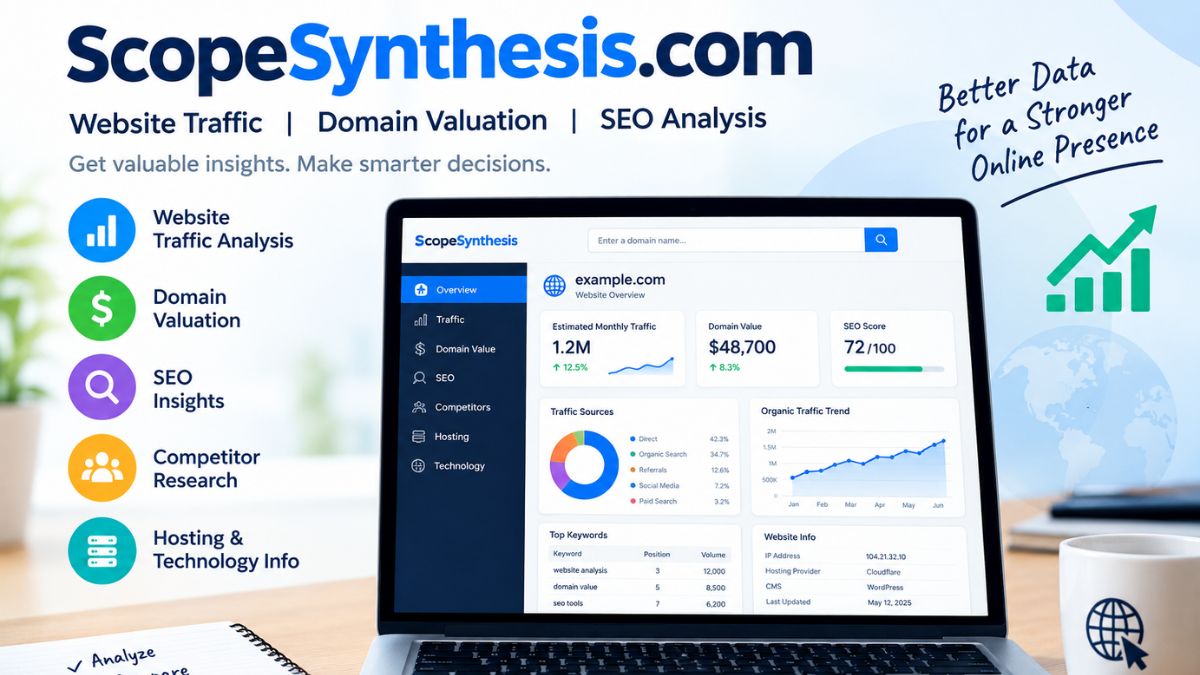
In the competitive world of digital marketing, understanding website performance is essential for website owners, bloggers, SEO professionals, and online businesses. ScopeSynthesis.com is a domain analytics platform designed to help users explore website traffic, estimate domain values, and examine important performance metrics. It aims to provide a practical alternative to established website analysis platforms by making useful domain information easier to access.
Whether you want to evaluate a competitor, research a potential domain purchase, or understand your website’s online presence, Scope Synthesis offers an approach centered on collecting and interpreting website data. According to its published description, the platform combines traffic insights, domain valuation, and SEO-related information in one place.
What Is ScopeSynthesis.com?
ScopeSynthesis.com is an online website analysis tool that helps users investigate the performance and potential value of domains. Instead of relying exclusively on a website’s appearance or published content, users can explore available analytical information to develop a better understanding of its digital presence.
The platform is designed for people who want to make informed decisions about websites, including digital marketers, bloggers, business owners, developers, and domain investors.
Its stated capabilities include website traffic analysis, domain valuation, SEO metrics, and technical information about website hosting. These features can be useful when researching competitors, evaluating business opportunities, or reviewing a website before investing time and money in it.
Key Features of ScopeSynthesis.com
1. Website Traffic Analysis
Website traffic is an important indicator of online visibility. Scope Synthesis aims to help users understand how websites attract visitors and where their traffic originates.
Traffic analysis can help website owners investigate potential audience sources, compare competing websites, and identify opportunities to improve their marketing strategies.
However, estimated traffic figures should not be treated as exact visitor counts. Actual website analytics from tools such as Google Analytics generally provide more reliable first-party information about a site’s visitors.
2. Domain Valuation
A domain name can become a valuable digital asset when it has strong branding potential, relevant demand, and a useful online history.
Scope Synthesis describes domain valuation as one of its main capabilities. Such estimates may help users begin evaluating a domain before purchasing, selling, or developing it.
Domain value can depend on several factors, including:
- Domain name length and memorability.
- Keyword relevance and commercial potential.
- Existing website traffic and search visibility.
- Quality and relevance of backlinks.
- Brand potential and market demand.
- Historical use and reputation.
Automated valuations should be considered estimates rather than guaranteed selling prices. Buyers and sellers should also review comparable sales and the domain’s history before making financial decisions.
3. SEO Performance Insights
Search engine optimization helps websites attract visitors through organic search results. Monitoring SEO-related metrics can reveal areas that may deserve further investigation.
Scope Synthesis positions itself as a platform for exploring website performance metrics, including SEO-related information. These insights may help users compare websites and investigate their search visibility.
For a more complete SEO strategy, website owners should also examine keyword rankings, content quality, search intent, indexing status, backlinks, and technical SEO issues.
4. Competitor Research
Competitor analysis is an important part of developing a successful online business. By examining competing websites, marketers can identify content opportunities, study audience acquisition strategies, and discover areas where their own websites may be underperforming.
Scope Synthesis can serve as a starting point for this research by bringing domain-related information together in a single analytical environment.
For example, a blogger planning a technology website could investigate established competitors, compare their apparent online presence, and use the findings to guide content planning.
5. Website Technology and Hosting Information
A website’s technical setup can influence its performance, security, reliability, and ability to scale.
Scope Synthesis describes its coverage as extending beyond traffic and valuation to technical website metrics, including hosting-related information.
Such information can provide useful background when researching websites or investigating competitors. Nevertheless, technical details should be verified independently before making decisions about hosting providers, website security, or infrastructure.
Who Can Benefit from ScopeSynthesis.com?
Bloggers and Content Creators
Bloggers can use website research tools to evaluate potential niches, investigate competing publications, and identify opportunities for content development.
For example, someone planning a finance, technology, travel, or lifestyle blog could research existing websites before deciding which topics to prioritize.
SEO Professionals
SEO professionals frequently need to compare domains, review competitor performance, and identify potential opportunities for organic growth.
A domain analysis platform can help organize preliminary research, although specialized SEO tools may still be necessary for detailed keyword tracking, backlink audits, and technical website analysis.
Website Owners
Website owners can use analytical information to better understand their online presence and identify areas requiring further investigation.
Combining domain research with first-party analytics and search performance reports can provide a more complete picture of website growth.
Domain Investors
Domain investors often evaluate names according to their branding potential, market demand, and commercial relevance.
Scope Synthesis’s domain valuation feature may help users conduct initial research. However, a domain should never be purchased solely because an automated tool assigns it a high estimated value.
Digital Marketing Agencies
Marketing agencies can benefit from tools that simplify initial domain research and competitor comparisons. These insights may support client discussions, market assessments, and campaign planning.
Agencies should verify important findings using additional data sources before presenting them as confirmed performance figures.
How to Use ScopeSynthesis.com
Using a website analysis platform generally involves a straightforward research process.
Step 1: Visit the Website
Open ScopeSynthesis.com in your browser and explore the available tools and features.
Step 2: Enter a Domain
If the platform provides a domain search function, enter the website address you want to investigate.
Step 3: Review Available Metrics
Examine the traffic estimates, domain valuation, SEO information, and technical details provided for the selected website.
Step 4: Compare Relevant Websites
Repeat the process for competing domains to identify similarities, differences, and potential research opportunities.
Step 5: Verify Important Findings
Use independent tools and reliable first-party information to validate important figures before making marketing, purchasing, or investment decisions.
The available data and specific features may change as the platform develops, so users should check the website directly for its current functionality and access requirements.
ScopeSynthesis.com Compared With Other Website Analysis Tools
Several established platforms offer website analytics and SEO research capabilities. Scope Synthesis positions itself as an alternative for users interested in domain traffic, valuation, and related metrics.
Popular alternatives include Similarweb, Semrush, and Ahrefs.
- Similarweb is commonly used to investigate website traffic, audience behavior, and competitive digital intelligence.
- Semrush provides tools for keyword research, SEO analysis, competitor research, and digital marketing.
- Ahrefs is widely used for backlink analysis, keyword research, and organic search competitor analysis.
- Scope Synthesis focuses on domain analytics, estimated website traffic, domain valuation, and additional website performance metrics.
The best option depends on your needs, budget, and the depth of data you require. Users should compare the platforms’ current features, limitations, and pricing rather than assuming that all metrics are equally comprehensive or accurate.
Benefits of Using ScopeSynthesis.com
One potential advantage of a domain analysis platform is the convenience of examining several categories of website information in one place.
Other potential benefits include:
- Simplified research: Explore available domain information without relying entirely on manual investigation.
- Competitive insights: Investigate competing websites and identify areas for further research.
- Domain evaluation: Obtain an initial perspective on the potential value of a website.
- Marketing support: Use available metrics to inform content and SEO planning.
- Time efficiency: Organize preliminary website research within a single platform.
The practical value of these benefits depends on the accuracy, coverage, and accessibility of the platform’s actual data.
Limitations to Consider
Although website analysis tools can be helpful, their results should be interpreted carefully.
Traffic estimates may differ significantly from actual visitor counts. Automated domain valuations cannot guarantee what a buyer will pay. SEO metrics may also vary between platforms because each provider uses different data sources and calculation methods.
Users should check whether the information is current, understand which metrics are estimates, and confirm important findings through independent sources.
It is also sensible to review the platform’s privacy policy and terms of service before submitting sensitive business information or connecting accounts.
Tips for Getting Better Results From Domain Research
To get more value from Scope Synthesis or a similar website analysis platform, follow a structured research process.
First, define your objective. Researching a competitor requires a different approach from buying a domain or auditing your own website.
Second, compare multiple relevant websites instead of judging a domain in isolation. Look for patterns in traffic, content, branding, and search visibility.
Third, combine estimated metrics with reliable sources such as Google Search Console, Google Analytics, and other relevant SEO tools.
Finally, use the findings to guide practical decisions. For example, if competitor research reveals an underserved topic, consider publishing useful, original content that directly answers the audience’s questions.
Is ScopeSynthesis.com Worth Exploring?
ScopeSynthesis.com may be worth exploring for users who want a convenient starting point for domain research and website performance analysis. Its stated focus on traffic insights, domain valuation, SEO-related metrics, and technical website information makes it relevant to bloggers, marketers, website owners, and domain investors.
However, its suitability depends on the features currently available and the reliability of the information it provides. Users who require advanced keyword research, detailed backlink analysis, or highly accurate visitor data may need to supplement it with other services.
The most effective approach is to test the platform against your specific research needs and compare its findings with trusted alternatives.
Conclusion
ScopeSynthesis.com is a domain analytics platform designed to help users explore website traffic, estimated domain values, SEO-related metrics, and other aspects of website performance. It offers a potential starting point for competitor research, domain evaluation, and digital marketing planning.
For bloggers, SEO professionals, online entrepreneurs, and domain investors, understanding these metrics can support better-informed decisions. Nevertheless, no single analytical tool provides a complete picture of a website’s performance or commercial value.
By combining Scope Synthesis with reliable analytics, independent verification, and a clear research strategy, users can gain more meaningful insights into the websites they manage, study, or consider purchasing.
Frequently Asked Questions (FAQs)
1. What is ScopeSynthesis.com?
ScopeSynthesis.com is an online domain analytics platform designed to provide insights into website traffic, domain valuation, SEO-related metrics, and other website performance information.
2. Is ScopeSynthesis.com free to use?
The platform has been described by a third-party software directory as offering a free option. Users should visit the official website to confirm current access conditions and any usage limitations.
3. Can Scope Synthesis estimate a domain’s value?
Yes. Domain valuation is one of the capabilities described by the platform. However, an estimated value is not a guaranteed selling price.
4. Who should use ScopeSynthesis.com?
Bloggers, website owners, SEO professionals, digital marketing agencies, and domain investors may find domain analysis tools useful for preliminary research.
5. Can ScopeSynthesis.com help with SEO?
Its stated SEO-related metrics may help users investigate website performance and competitors. A comprehensive SEO strategy may require additional tools for keyword research, backlink analysis, indexing checks, and technical audits.
6. Is Scope Synthesis an alternative to Similarweb?
Scope Synthesis positions itself as an alternative to Similarweb for domain and website analysis. The best choice depends on the data, features, and level of detail required.
7. Are website traffic estimates always accurate?
No. Third-party traffic estimates can differ from actual website analytics. For your own website, first-party analytics and search performance data are generally better sources for measuring real performance.
8. How can I get started with ScopeSynthesis.com?
Visit the website, review its available features, enter a domain if a search tool is available, and examine the resulting information. Verify important findings before making decisions.
-

 TOPIC1 year ago
Top 5 Features of Googlediqiu You Didn’t Know About
-

 TOPIC2 years ago
Why Large Waterproof Outdoor Rugs Are Essential for All Outdoor Spaces
-

 FASHION2 years ago
How to Layer Your White Dress for Cold Weather?
-

 FASHION1 year ago
How to Choose Sunglasses That Perfectly Complement Your Summer Wardrobe
-

 TOPIC2 years ago
7 Expert Tips For Choosing The Best Basement Renovation Companies
-

 BUSINESS1 year ago
Top 5 Features of Sowix Online That Every User Should Know About
-

 TOPIC1 year ago
Why Greece Katz Martian Has Everyone Talking in 2025
-

 FINANCE2 years ago
How TraceLoans Can Simplify Your Finances